From Green Standards to Carbon Accounting, Construction Priorities are Evolving Rapidly.
By Anna Griffin, Head of Sustainability & Advocacy, Holcim UAE and Oman
The construction industry has spent decades building a sustainability framework, and the progress is real. Green building standards like LEED and BREEAM have long weighted ecology, water efficiency, and biodiversity alongside energy performance. More recently, embodied carbon foot-printing has emerged as the next technical frontier, as developers and asset owners begin accounting for emissions across the full material lifecycle, not just in building operation. That evolution reflects a maturing sector, one capable of holding multiple priorities at once.
Decarbonization, circularity, and biodiversity now converging priorities
The next horizon is regenerative, nature-positive construction and it is not a departure from decarboniZation. It is the logical extension of it.
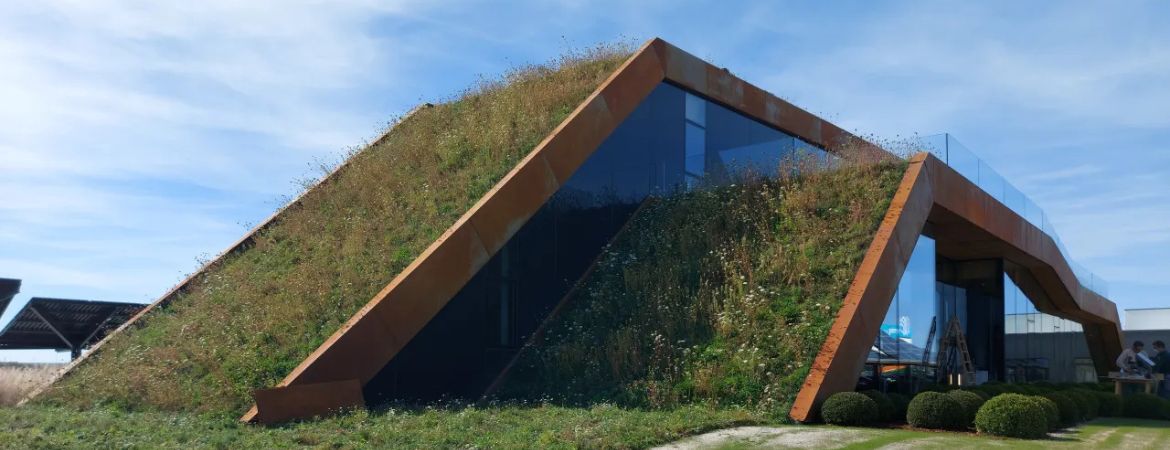
A genuinely comprehensive net-zero strategy cannot stop at the boundary of a building’s carbon account; it must look at how our structures interact with the living systems around them. The future belongs to “smart buildings” structures that do not just minimize resource consumption through digital efficiency, but actively integrate with nature to manage microclimates, optimize water cycles, and foster urban biodiversity. Decarbonization, circularity, and ecological restoration are not competing priorities to be traded off against one another. They are converging ones, and the industry is well-placed to pursue them together.
In our work, we are already seeing what this integrated approach looks like in practice. It means developing permeable concrete systems designed to actively recharge groundwater and support urban tree coverage, alongside circular construction technologies that close the loop on demolition waste at scale.
Designing infrastructure that restores environments above and below water
Crucially, in a region defined by its vital coastal ecosystems, it also means moving innovation beneath the waterline. By utilizing specialized bioactive concrete, we can design maritime infrastructure that mimics natural marine habitats. Rather than disrupting local ecosystems, these marine-optimized materials actively encourage the colonization of native marine life and support the health of surrounding mangrove networks.
Dubai aggressively expanding its marine sanctuaries and coastal nature reserves
In the UAE, the national ambition is driving progress across every Emirate. While Abu Dhabi has planted upward of 44 million mangroves toward the UAE’s national target of 100 million by 2030, Dubai is aggressively expanding its marine sanctuaries and coastal nature reserves, and the Northern Emirates are heavily prioritizing the protection of their unique mountain and marine biodiversity. Translating this unified federal commitment to the level of individual construction projects is the industry’s next obligation. Nature-positive outcomes must be treated as a standard deliverable across all projects, alongside cost, timeline, and carbon.
To achieve this, we are grounding our efforts in robust science. By developing biodiversity targets using science-based methodologies in partnership with bodies like the International Union for Conservation of Nature (IUCN), we are proving that ecological health can be quantified and tracked.
The same rigor that now applies to carbon accounting must be built around ecological impact. The tools are developing, and the standards are maturing. The sector has the knowledge, the technology, and the commercial incentive to design projects that restore as well as build. The task now is making regenerative design the baseline expectation, not the exception.
FOR MORE INFORMATION: