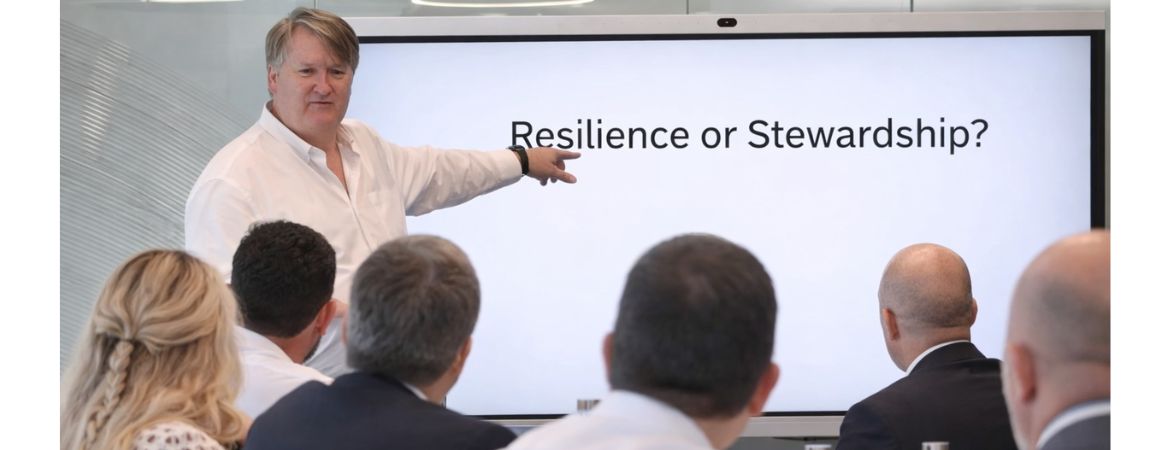
Why disciplined leadership matters more than speed in uncertain markets.
Emirates Projects Contributor Simon Lewis, Founder and CEO of 3D ACTIO and Vistage UAE Chair, is a business leader and advisor specializing in leadership development, growth strategy, and organizational transformation.
In a previous article, I compared an oil tanker to a speedboat to illustrate today’s turbulent business environment in the Middle East. The message was straightforward: a speedboat can pivot quickly, but an oil tanker cannot. It carries weight, risk, people, contracts, and consequences. The same applies to large organizations across oil and gas, construction, and development. Constantly shifting direction in response to headlines is not only impractical, it can be damaging. In volatile conditions, a sudden change can create more disruption than the wave itself. While speed has its place, it can also introduce instability. Fortification builds resilience, but resilience alone is not enough.
That’s why stewardship is the better focus
“Resilience” has become a widely used term, repeated so often it risks losing meaning. Of course, resilience matters. Every business must withstand pressure and remain operational. But today’s leaders are expected to do more than endure uncertainty, they must navigate through it. They must guide people, protect value, and move the organization forward without losing control.
The more powerful question, then, is not “How do we become more resilient?” but “How do we steward the business through uncertainty without losing direction?”
That shift in thinking changes everything
Stewardship is practical and relevant at every level. At the board level, it means disciplined, not emotional, decision-making. At the executive level, it means safeguarding cash flow, people, operations, and trust. On-site, it requires clear priorities, calm communication, and safe execution. On the front line, it means focusing on what matters most today, even when the broader picture is unclear.
Lead with clarity, not reaction
Most importantly, stewardship gives people a defined role. Resilience can feel like an abstract concept handed down from leadership. Stewardship, by contrast, is a responsibility. It calls for action: protect what must not fail; avoid chasing every disruption; adjust pace before direction; remain transparent about risk; and lead with clarity, not noise.
This is what makes stewardship stronger than resilience. It is active, not reactive. It is about maintaining control, not just absorbing impact. Without it, even resilient organizations can drift, becoming reactive, inefficient, and ultimately less competitive. They may survive each challenge, but lose momentum, erode trust, and weaken their long-term position.
Lead with clarity, not reaction
Too often, resilience is framed as simply enduring hardship. But in reality, businesses need more than endurance, they need direction. They need leadership that provides clarity, structure, and confidence. They need to know the organization is being guided, not just tested.
This is the fundamental difference: resilience helps a company withstand the storm; stewardship ensures it reaches calmer waters with its people, purpose, and performance intact.
From my work with STRATEGISE and ongoing conversations with Vistage members, a subtle but important shift is emerging. While resilience remains part of the conversation, forward-thinking leaders are increasingly embracing stewardship. In times like these, that shift may determine whether a business simply survives or emerges stronger, more focused, and ready for sustainable growth.
FOR MORE INFORMATION: